
As previously asserted by Akhil Ramesh and Florence Principe Gamboa, the US-Philippine alliance has an opportunity to expand beyond the traditional security treaty of the Enhanced Defense Cooperation Agreement (EDCA) of 2014 into economic integration. The Pax Silica initiative could potentially become the democratic, private sector-led alternative to certain elements of China’s Belt and Road Initiative. It aims to transform the Philippines, particularly the newly designated 4,000-acre industrial hub in New Clark City, into a critical and diversified manufacturing hub for tech supply chains. However, following Under Secretary Jacob Helberg’s visit to the Philippines on May 18, the fog obscuring the gap between diplomatic pledges and ground-level reality is beginning to clear. Pax Silica can only fully succeed if the US accepts Philippine institutional constraints while helping the Philippines move beyond assembly into higher-value semiconductor activities.
A divergence in interests
Table: A comparison between US-Philippine frameworks on Pax Silica negotiation
| Philippine Special Economic Zone (SEZ) Framework | US Economic Security Zone (ESZ) Proposal | |
| Legal Basis | SEZ Act (RA 7916, 1995), BCDA Law (RA 7227, 1992) | US-backed Pax Silica initiative |
| Primary Objective | Attract foreign capital, economic growth, and job creation | Secure US tech and mineral supply chains to reduce reliance on China |
| Jurisdiction | Governed by Philippine local laws and courts | Led by Economic Affairs Under Secretary Jacob Helberg and the State Department |
| Land & Leases | Investors’ Lease Act (RA 7652, 1993); amended in 2025 for up to 99-year leases | Secured a 2-year rent-free grace period for pre-development and planning |
| Status | Active standard for all Philippine economic hubs | Agreed to operate without extraterritoriality and diplomatic immunity |
To understand the friction in ongoing negotiations, one must view Pax Silica through the principal’s lens and understand Manila’s legal limitations. Helberg lays out the entire strategy in his book The Wires of War, arguing that in modern geopolitical competition the technology stack itself is the battlefield. Creating a forward-deployed industrial base for its tech supply chain is a security imperative. As a result, Washington explored the idea for New Clark City to be an Economic Security Zone, and reports—which Helberg later disputed as taken out of context—indicated Washington had sought diplomatic immunity and even US jurisdiction, though unsuccessfully. The Philippines, through the Bases Conversion and Development Authority’s (BCDA) President and CEO Joshua Bingcang, maintains a commercial and constitutional lens within an established special economic zone framework. Consequently, Bingcang ruled out diplomatic immunity, ensuring the hub operates within the Philippine sovereign frameworks so as to not involve any congressional action. A difference in primary objectives can be understood: Washington wants a secure and predictable environment to deploy capital and diversify supply chains away from China; Manila wants jobs, sovereign integrity, and an opportunity to climb up the semiconductor value chain by processing its abundant critical minerals locally, rather than exporting them.
Escaping the Smiley Curve trap
The US companies part of the visit in May 2026 harbored potential as the future of dual-use technology. However, based on their current production capacity, most are years away from offshoring. On the other hand, the presence of Foxconn Chairman Young Liu represents the real and immediate momentum of the initiative. Foxconn, a Taiwanese firm, is rooted in high-volume electronics assembly for US and allied markets. The Philippines, holding an edge in semiconductor assembly, testing, and packaging (ATP), is well-positioned to expand the industry. However, to add nuance, the Smiley Curve economic model should be considered, which states that production and assembly yield the highest volume of employment, but garner the lowest share of economic value-added. For Pax Silica to be a true win-win, the Philippines cannot settle for being the low-margin assembly floor of the alliance. The inflow of capital must jumpstart industries up the curve like design as well as research & development.
The energy hurdles
Even if the differences in legal frameworks are resolved, a physical implementation gap remains: infrastructure. Advanced semiconductor packaging and AI datacenters require massive and secure baseload power. The industrial zone alone is expected to need 5,000 megawatts of generating capacity, around a 35-40% increase from the roughly 13,000 to 14,000 megawatt peak demand of the Luzon grid. Furthermore, the Philippines has among the most expensive electricity costs in Southeast Asia. According to early 2026 grid data, the Philippine industrial rate stands at 14.74 cents/kWh, approximately 34.8% higher than Vietnam’s rate of 10.93 cents/kWh and 11.0% above the included regional average.
Figure: Southeast Asia energy grid comparison
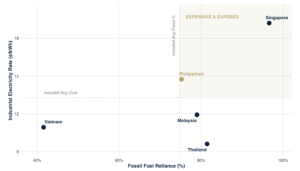
Source: Ember Monthly Data (2026) & International Electricity Rates (PH DOE). Note that averages reflect only the plotted countries, due to data availability limitations. Exposure is based on total electricity generation from fossil fuels; vulnerability to import disruptions varies depending on a nation’s domestic energy production. 1 USD = 60.39 PHP.
Furthermore, the Philippine grid remains reliant on fossil fuels for electricity generation (75.21%), making it vulnerable to price shocks such as those triggered by the recent Middle East conflicts. Compounding this is a geopolitical issue—the National Grid Corporation of the Philippines (NGCP) is 40% owned by China’s State Grid Corporation. These conditions make the business calculus far from ideal and, according to some analysts, make the investment pledges shaky. Expecting allied capital to invest in its supply chain on a grid that is expensive, volatile, and partially influenced by a strategic competitor is impractical.
A policy action plan
Both nations have established a two-year window, strengthened by the BCDA’s provision of a two-year, rent-free period to agree on terms for the hub. To succeed, Washington and Manila should navigate within solutions that address both sides’ interests.
- Leverage the Philippines’ SEZ and BCDA Framework
The US does not need to reinvent the wheel here to secure its supply chains: the blueprint already exists within the Philippine SEZ framework. Much like other SEZ’s around the world, such as Singapore’s Jurong Island model and the United Arab Emirates’ Jebel Ali Free Zone, all developed centralized, ring-fenced infrastructure to attract global capital. The BCDA can build out embedded physical and cyber-security architectures within the existing law. Section 5 of RA 7227 empowers the BCDA to construct, own, and operate public utilities and other infrastructure facilities. This provision allows for the integration of US-vetted cybersecurity protocols and other operating procedures addressing Washington’s security concerns.
- Deploy capital for energy needs
The hub must implement sustainable embedded power solutions to bypass the geopolitical issues and the high costs of the NGCP. The BCDA is already showing progress with this by facilitating a 500 MW solar-plus-storage project with Acwa, a Saudi Arabian firm. Other US private equity firms like I Squared Capital, co-owner of Aggreko, can bridge more of the baseload gap by deploying modular power solutions. However, at this scale, the above developments can only meet a portion of the energy needs. For a more long-term answer, Manila should continue improving its energy infrastructure away from fossil fuels and towards other scalable solutions using the influx of capital: solar-plus-storage frameworks, offshore wind (OSW), hydropower, and even small modular nuclear reactors.
- Ascend the Smiley Curve in phases
While the Philippines will naturally expand its existing ATP industry, policy must direct capital to push the local economy up the value chain. First, this means establishing formal and streamlined procedures to facilitate the use of local critical minerals under local ownership—directly feeding the supply chain. Second, while decades away from fruition, the ultimate goal should be to move the industry towards R&D and design, representing the high-value and low-power-consumption end of the Smiley Curve. This means following in the footsteps of Taiwan and arranging tech-transfer agreements, among other policy initiatives. The Philippines readily possesses a massive, English-speaking, and underutilized IT and engineering graduate pool that the tech ecosystem can upskill.
Anchoring the alliance
Pax Silica’s long-term success hinges on balancing two objectives: America’s need for secure technology supply chains and the Philippines’ need to upgrade its industrial base. The initiative will fall short of its strategic potential if New Clark City remains an entirely low-level manufacturing hub. Given the wide zone of possible agreement, both sides will likely gain if the correct policies are implemented. And when that happens, Pax Silica could become the economic anchor of the alliance for decades to come.
Rafael Munoz ([email protected]) is a commissioned officer in the Philippine Army, a Graduate Research Assistant at the University of Hawai’i Economic Research Organization (UHERO), and a Master of Public Administration candidate at UH Mānoa. He is an alumnus of the United States Military Academy at West Point.
Media: New Clark City
The Pilot commentaries and responses represent the views of the respective authors. Alternative viewpoints are always welcomed and encouraged. Please write to [email protected] for more information on how to contribute.